Conventional stadium PA · long throw
Amplified across the venue
3 ft135 dBat the speaker
330 ft95 dBfar seat
¼ mile81 dBparking lot
0.6 mile75 dBhomes
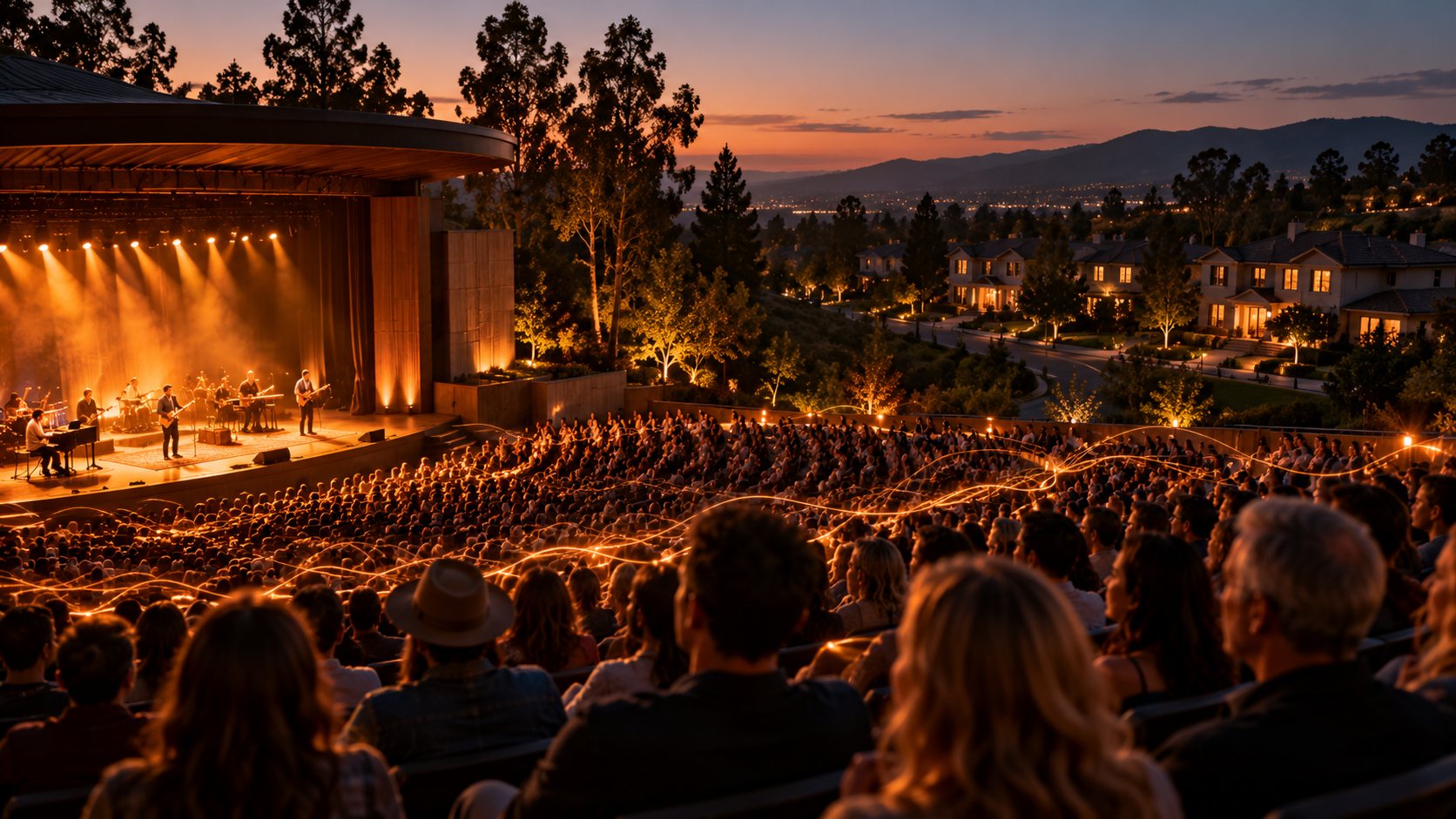
Curfews, noise limits and neighbors who complain after every show are now part of running a venue. The cause is simple physics: sound thrown a long way has to start loud, and it keeps going. VIP delivers sound in the near field, a couple of feet from each guest, so far less of it ever leaves the venue.
Sound loses about 6 dB every time the distance from its source doubles. A stadium PA has to be loud enough to reach the last seat, so it is still loud when it reaches the parking lot and the homes beyond. VIP starts a couple of feet from each listener, so it only has to be loud enough to cross that short distance, and it fades away within a few rows.
Level from one source as it travels away. Each line is set so the listener hears the same 95 dB. Distance is on a log scale, so every step to the right doubles or multiplies the distance.
To give a fan the same 95 dB, VIP starts about 40 dB quieter. That is ten thousand times less acoustic power leaving each source.
Sound from a source spreads over a growing sphere, so its intensity falls with the square of the distance. Two and a half feet to five feet costs 6 dB. Five feet to ten feet costs another 6.
A PA reaching a seat 330 ft away must start about 40 dB louder than the level fans hear. A source 2.5 ft from the ears starts almost at the listening level, because there is so little distance to lose.
Over long distances the air absorbs high frequencies but barely touches bass. That is why neighbors hear the thump of a show. Wind and evening temperature inversions can carry it even farther.
How these numbers are worked out. Free-field inverse-square law (−6 dB per doubling of distance) from a single source, with each source set so the listener hears 95 dB. PA: 95 dB at a seat 100 m (330 ft) away needs about 135 dB at 1 m. VIP: 95 dB at 0.75 m (2.5 ft) needs about 92.5 dB at 1 m. The figures leave out air absorption, wind, ground effects, reflections off the bowl and speaker directivity, so they show the principle rather than a prediction for a specific venue. In a full venue many seat sources play at once and add together, so real-world results depend on system design and the room.
Sources: SFU Handbook for Acoustic Ecology, Inverse-Square Law · Stanford CCRMA, Air Absorption · Institute of Acoustics, Noise control procedure for open-air pop concerts